Cattle Weaning and Weight Records That Actually Help Sell Calves
Weaning and weight records that move calves at sale time — what to weigh, when, and how to turn it into a buyer-ready sheet.
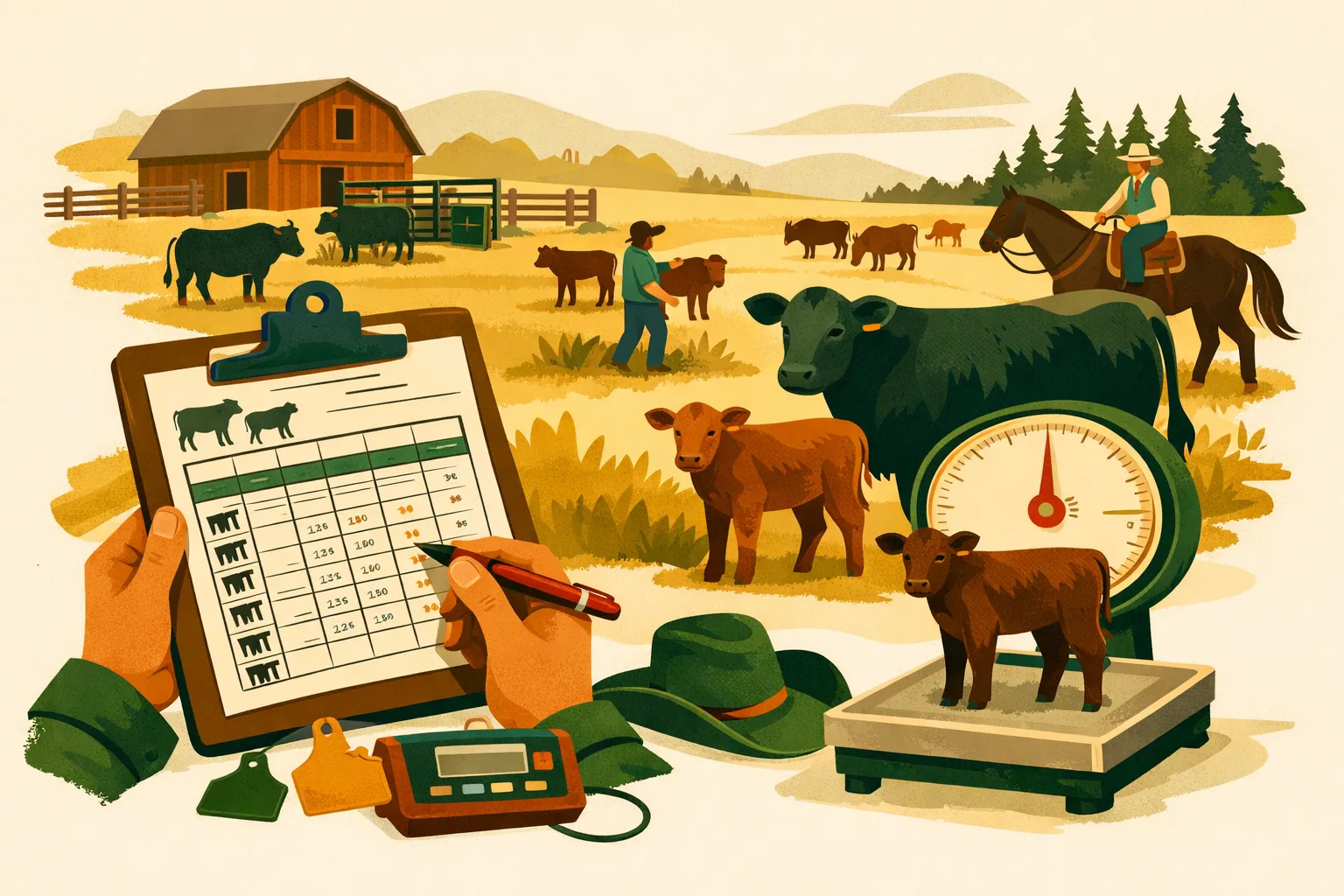
Understanding the Importance of Cattle Weaning and Weight Records
For cattle producers, maintaining accurate and comprehensive weight records is essential for optimizing herd performance and maximizing profitability. Weaning weights, Average Daily Gain (ADG), and adjusted 205-day weights are not just numbers; they are critical data points that can significantly influence the marketability of your calves. Buyers are increasingly looking for robust performance data to make informed purchasing decisions. Leveraging these records effectively can enhance your operation’s reputation and profitability.
The Role of Weaning Weights in Calf Marketing
What Are Weaning Weights?
Weaning weight is the weight of a calf at the time of weaning, typically between 5 to 8 months of age. This metric is crucial as it reflects the calf’s growth potential and the genetic merit of both dam and sire. It also serves as an indicator of the cow’s milk production capabilities.
Why Weaning Weights Matter
- Buyer Confidence: Buyers prefer calves with documented growth performance, as it reduces the risk associated with their purchase.
- Genetic Evaluation: Weaning weights are used in calculating Expected Progeny Differences (EPDs), providing insights into the genetic potential of your herd.
- Management Decisions: Identifying underperforming calves early allows for management interventions to optimize growth.
Calculating Average Daily Gain (ADG)
How to Measure ADG
Average Daily Gain (ADG) is a measure of how much weight a calf gains per day over a specific period. It is calculated using the formula:
[ \text{ADG} = \frac{\text{Weight at Weaning} - \text{Birth Weight}}{\text{Age in Days}} ]
Importance of ADG
- Performance Benchmark: ADG provides a benchmark to assess the efficiency of your feeding programs.
- Profitability Indicator: Higher ADG typically translates to lower production costs per pound of gain.
- Market Readiness: Knowing ADG helps in planning when calves will be ready for market, optimizing sale times for peak prices.
Adjusted 205-Day Weights: A Standardized Metric
What Are Adjusted 205-Day Weights?
To account for variable weaning ages, the adjusted 205-day weight provides a standardized weight measure. This adjustment allows for fair comparisons between calves.
How to Calculate Adjusted 205-Day Weight
The formula for adjusted 205-day weight is:
[ \text{Adjusted 205-Day Weight} = \left( \text{Weaning Weight} - \text{Birth Weight} \right) \times \frac{205}{\text{Age in Days at Weaning}} + \text{Birth Weight} + \text{Adjustment Factor} ]
Why Use Adjusted 205-Day Weights?
- Standardization: Allows for equitable comparison between calves of different ages.
- Genetic Selection: Facilitates better selection decisions for breeding purposes.
- Buyer Insight: Offers potential buyers a normalized metric to compare calves from different herds.
Comparison Table: Weaning Weights vs. Adjusted 205-Day Weights
| Metric | Purpose | Calculation Method | Key Advantage |
|---|---|---|---|
| Weaning Weight | Assess growth potential at weaning | Measured directly at weaning age | Direct measure of growth |
| Adjusted 205-Day Weight | Standardize weight for age differences at weaning | ((\text{Weaning Weight} - \text{Birth Weight}) \times \frac{205}{\text{Age in Days at Weaning}} + \text{Birth Weight}) | Enables fair comparison across calves |
Practical Checklist for Managing Cattle Weight Records
- Regular Weighing: Ensure calves are weighed at birth, weaning, and at regular intervals to monitor growth.
- Data Entry: Record weights promptly in a reliable system to avoid data loss.
- Calculate ADG and Adjusted Weights: Use formulas to compute ADG and adjusted 205-day weights.
- Benchmarking: Compare data against industry standards and historical herd performance.
- Review and Analyze: Regularly review records to identify trends and make informed management decisions.
How HerdFlo Helps
Accurate record-keeping is crucial, but it can be time-consuming and prone to errors. HerdFlo simplifies and automates this process, allowing you to efficiently track and analyze cattle weight records. By using the free HerdFlo app, you can:
- Automate Calculations: Instantly compute ADG and adjusted 205-day weights with built-in formulas.
- Centralize Data: Store all weight records in a single, easy-to-access platform.
- Generate Reports: Create comprehensive reports for buyer presentations and herd evaluations.
- Integrate with FarmsFlo: Combine herd data with full-operation records for a holistic view of your farm’s performance.
Streamline your cattle management processes and enhance your operation’s profitability by signing up for the free HerdFlo app at herd.farmsflo.com. For a complete farm management solution, integrate with FarmsFlo at farmsflo.com.